



When Good Deeds Become a Movement
Md. Nurul Karim Bhuiyan on building a culture of compassion, recognition and civic responsibility through “Good Deeds, Good People”
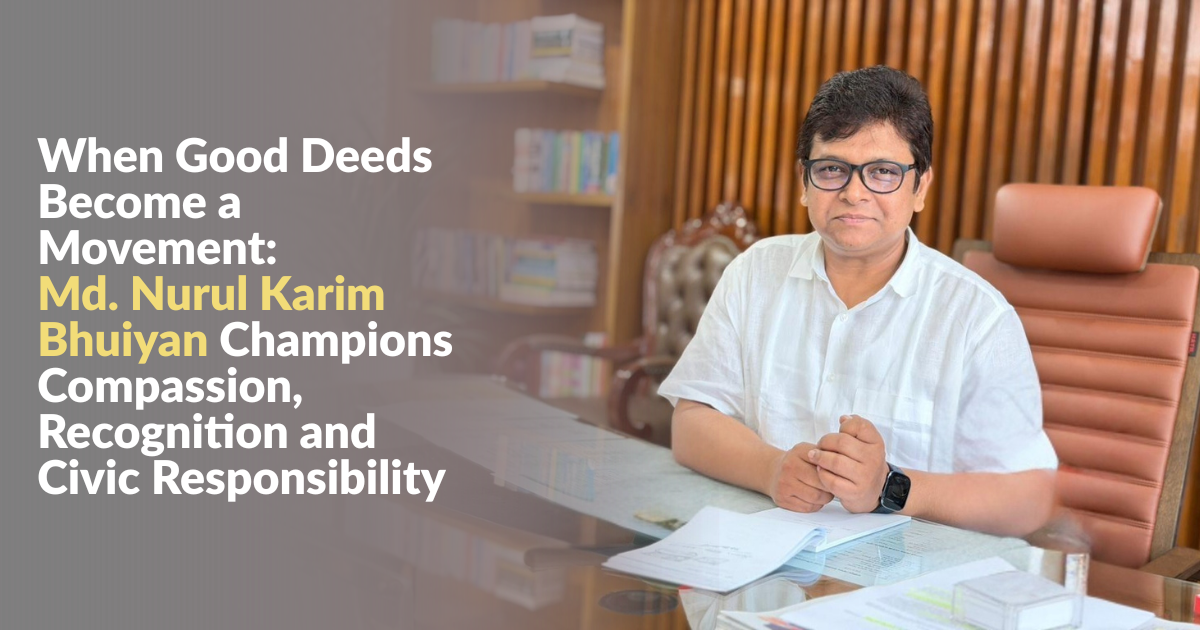
Md. Nurul Karim Bhuiyan on building a culture of compassion, recognition and civic responsibility through “Good Deeds, Good People”
Every society has people who quietly make a difference. They may be helping disadvantaged children, caring for abandoned animals, protecting the environment, supporting people with disabilities, assisting families in difficult circumstances or contributing to their communities in ways that rarely receive public attention. Their work may not always be large enough to make headlines, but it often carries a significance far greater than its scale suggests. What they need is not necessarily fame or reward, but recognition, encouragement and, in some cases, the support that can help them do more.
It is from this belief that “Good Deeds, Good People” has emerged as one of the distinctive initiatives associated with Md. Nurul Karim Bhuiyan, District Commissioner of Gazipur. At its heart, the initiative seeks to identify people who are doing meaningful work for others, recognise their contributions and create greater awareness around the positive things already taking place within society. More importantly, it reflects Nurul’s broader vision of what public administration can become when it moves beyond responding to wrongdoing and begins actively encouraging people who are contributing to the greater good.
“Administration is not just there to catch the guilty and punish them. It’s also a role of the administration to encourage people who are doing good and reward them,” Nurul explains.
The statement captures a significant shift in perspective. Public administration is traditionally associated with rules, enforcement and solving problems after they arise. Nurul believes it can also play a proactive role in recognising the people who are preventing problems, helping others and creating positive change within their communities. For him, changing that perception is part of creating a new relationship between citizens and the institutions that serve them.
“I felt it’s about time that the administration changed its role. People’s perception about administration is changing. We are trying to create new norms in public administration and services.”
Recognising the Good That Already Exists
The philosophy behind the initiative begins with an observation that is both simple and profound: there are already many good people doing meaningful things around us, but their contributions are often overlooked.
Society tends to devote considerable attention to crime, conflict and wrongdoing. The stories that attract the greatest attention are frequently those involving problems, while people who quietly contribute to their communities continue their work without recognition. Nurul believes that this imbalance can be corrected by deliberately directing attention towards those who are making a positive difference.
“We give a lot of energy to people who are doing bad things. If we invest some of the energy in good people, there will be more output.”
For the people being recognised, that acknowledgement can mean considerably more than a certificate or public appreciation. Many of them operate with limited resources and continue their work because of a personal conviction that something needs to be done. Recognition can give them the confidence that their efforts matter, while greater visibility can potentially connect them with people and institutions capable of supporting their work.
“I believe there are many, many good people in the society who are doing things without any return. I believe if we can promote them and their works, even more people will come forward and do good.”
That is what makes the initiative particularly relevant. It is not based on the assumption that meaningful social change must always begin with large organisations, major funding or government programmes. Sometimes it begins with an individual who simply decides to help.
Small Actions, Larger Consequences
Nurul’s approach is built around the belief that social transformation cannot be achieved overnight. A country cannot simply eliminate crime, social problems or harmful behaviour through a single policy. Change has to develop through everyday actions and attitudes, with small acts gradually influencing the behaviour of wider communities.
“We all want a country free from crimes and bad things. But it cannot be done overnight. The only way we can start that is by encouraging small good things that will infect and collect eventually to become something grand and more impactful. We are not waiting for tomorrow to start; we are doing this today.”
This philosophy gives importance to the scale of the intention rather than the scale of the action. Someone who helps one child, protects one animal, cleans one public space or supports one vulnerable person may not appear to be changing the country, but that action represents a choice about the kind of society that person wants to live in.
“The work might be small but the big impact that it could have is what we are trying to focus on with this initiative.”
The objective, therefore, is not merely to collect stories of good deeds. It is to create an environment where those stories inspire others and gradually influence social behaviour.
Giving Good People the Confidence to Do More
One of the most compelling aspects of the initiative is its understanding that people who want to contribute do not always have the resources to match their intentions.
A person may have the compassion to help others but lack financial means. Someone may have established a small organisation but struggle to expand it. Another individual may have spent years working quietly within a community without ever receiving institutional recognition. In such cases, encouragement can become an important form of support.
Nurul wants those individuals to understand that their work is visible and that public institutions can stand beside them.
“I want to make them feel like we are, as an administration, administrators and country, there with them, supporting them.”
The initiative therefore creates a bridge between citizens who are already contributing and an administration that can help bring greater attention to their efforts. In cases involving education, disability support, community welfare or other social causes, recognition can potentially lead to further opportunities, partnerships and assistance.
The underlying message is particularly powerful: you do not have to be wealthy, influential or powerful to contribute to society. What matters first is the willingness to care.
Creating a Culture Where Goodness Is Contagious
Bhuiyan’s vision extends beyond recognising existing acts of kindness. He wants good behaviour to become something that people actively encourage within one another.
This is particularly evident in his thoughts about children and creativity. He believes that young people are often introduced to the world through a constant series of restrictions—what they cannot do, where they cannot go and what they should not attempt. While boundaries are necessary, he worries that an excessive culture of prohibition can suppress curiosity and creativity.
“We want to release people of ‘no’, especially kids. Every sentence contains a no. We always impose rules, restrictions and decisions on everyone, especially from childhood to kids, that continues on. We want to build a society that is free from that ‘no’ behaviour.”
His idea is not to remove discipline or responsibility, but to create more room for imagination and initiative. He wants children to explore, experiment and develop the confidence to think beyond conventional limitations.
“We want kids to explore, be creative and go out of the box. We don’t want to keep them tied to the norms of restrictions over doing everything.”
That philosophy connects directly with the broader purpose of “Good Deeds, Good People.” If people are encouraged from an early age to look around them, identify problems and think about how they can contribute, civic responsibility becomes less of an imposed obligation and more of a natural part of everyday life.
A New Role for Public Administration
Nurul’s own journey through public service has reinforced his belief that institutional change and human change must happen together.
During his time as an administrator, he has witnessed suffering, frustration and tears among the people he serves, but he has also seen moments of happiness and relief. Those experiences have shaped his understanding that administration is ultimately about people rather than processes alone.
“During my time as an administrator, I saw the people’s sufferings and tears. At the same time, I am also seeing tears of joy in the eyes of the people.”
He does not suggest that every problem can be solved immediately. Instead, he believes that the administration must be willing to identify its weaknesses, learn from experience and gradually improve the systems that serve citizens.
“The faults of our systems will be surfaced and mended. Hopefully we can fix them, treat them and bring some healing.”
He also sees considerable potential within the public service itself. According to Nurul, many government officials possess strong educational backgrounds, experience and the ability to contribute meaningfully when given the right leadership and direction.
“Most of them are gems. We need the government’s leadership and guidance, and I am hopeful we will be able to receive that slowly from our government.”
His ambition is for successful models developed in Gazipur to eventually encourage similar approaches elsewhere, creating a wider culture of citizen participation and socially conscious administration.
The Chair Belongs to the People
Although Bhuiyan has been serving as District Commissioner of Gazipur for only five months, he says he has already experienced a sense of acceptance from the people he serves. Yet when he speaks about the legacy he hopes to leave, he deliberately moves the focus away from himself.
“I don’t want publicity for myself, I want this chair to be glorified.”
For him, the position of District Commissioner should represent responsibility rather than personal status. Whoever occupies the position should understand that the authority associated with the office ultimately exists to serve the people.
“That means people who will sit in this chair will take responsibility for all the people in this area and this chair belongs to all the people in this area.”
It is a philosophy that places public trust at the centre of administration. The success of an initiative such as “Good Deeds, Good People” is therefore not measured only by how many individuals are recognised, but by whether people begin to feel that their contributions are seen, valued and supported.
A Better Country Begins With How We Treat One Another
The most compelling part of Nurul’s vision is perhaps its simplicity. He is not suggesting that one initiative can solve every social problem in Bangladesh. Instead, he is arguing for a change in emphasis: alongside addressing what is wrong, society must become equally intentional about recognising what is right.
A person who helps another without expecting anything in return, someone who dedicates time to children with disabilities, an individual who protects animals, a citizen who takes responsibility for the environment or a community member who quietly supports someone in need may never consider themselves extraordinary. Yet these are precisely the people Bhuiyan wants society to notice.
For him, “Good Deeds, Good People” is ultimately about giving such individuals something they often lack—not necessarily money, fame or status, but the assurance that their efforts matter.
“When the government will encourage them, the courage that they will get will not just be enjoyed by the self, it will be reaped by all the people in the country.”
That belief gives the initiative its larger significance. Recognition becomes a form of encouragement; encouragement creates confidence; confidence allows people to expand their efforts; and those efforts can influence others to participate in their own way.
Nurul’s ultimate ambition is correspondingly much larger than Gazipur.
“We want the people in Bangladesh to know about our work. We want to create a positive impact through this small initiative. The more people will know about it, the more people will accept it.”
He envisions a Bangladesh that is greener, more peaceful and more prosperous, but he believes such a future has to be built through the behaviour of its people as much as through its institutions.
Perhaps that is the most important idea behind “Good Deeds, Good People”: a better society does not begin only when governments introduce major reforms or institutions create ambitious programmes. It also begins when ordinary people recognise that their choices have consequences, that compassion has value and that even an act carried out without expectation can influence the world around them.
The people Nurul seeks to recognise are already demonstrating that principle. His initiative simply asks society to look closer, acknowledge their contribution and give them the encouragement to continue. In doing so, it proposes a different way of imagining public service—one in which administration does not merely respond to the problems of society, but actively helps nurture the people who are already trying to make it better.