


Mir Hasib Mahmud: Building Bangladesh’s Next Generation of Leaders Through Education, Innovation, and Industry
By The Fame In a country where nearly two million young people enter the workforce every year, Bangladesh’s greatest
By The Fame
In a country where nearly two million young people enter the workforce every year, Bangladesh’s greatest challenge is no longer access to education—it is the transition from education to employability. Universities continue to produce graduates in large numbers, yet employers frequently report a shortage of candidates equipped with the practical skills, professional mindset, and industry exposure required in today’s rapidly evolving economy.
Few individuals have chosen to confront this challenge as directly as Mir Hasib Mahmud.
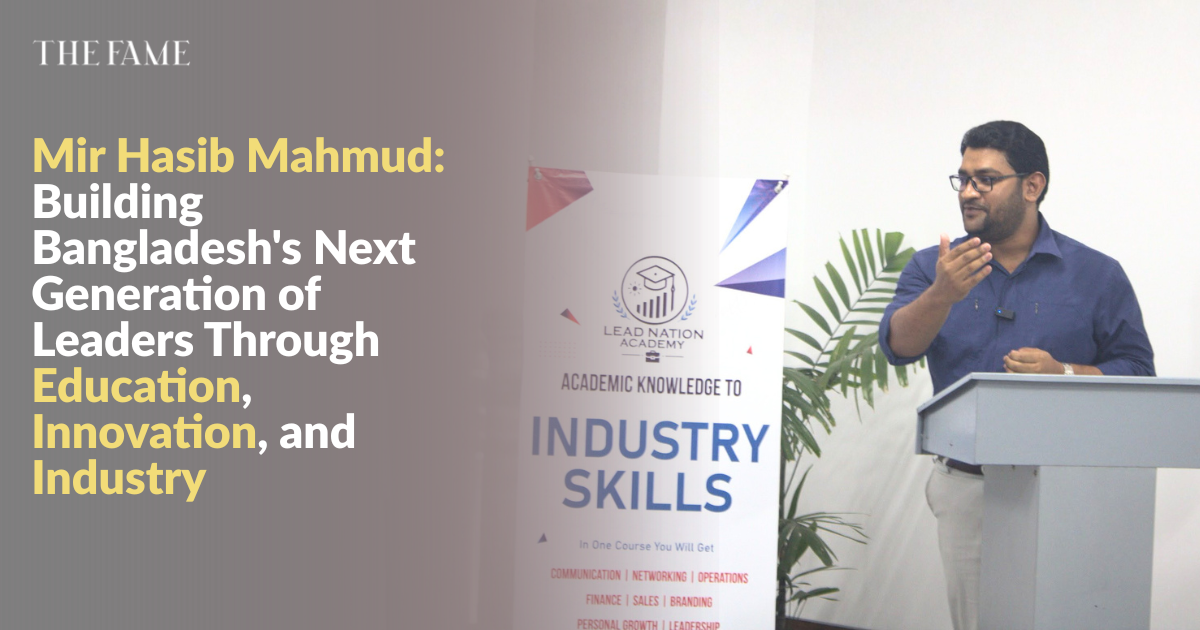
An academic, entrepreneur, researcher, and youth development advocate, Mahmud has quietly emerged as one of the young professionals attempting to redefine how higher education connects with the world of work. As an Assistant Professor at Sonargaon University (SU) and Advisor to the Center for Research, Training & Consultancy (CRTC), he works within academia to shape future graduates. Through Lead Nation Academy (LNA), the institution he co-founded, he has created a platform designed to bridge one of Bangladesh’s most persistent development gaps—the disconnect between classrooms and careers.
His journey represents a growing movement among educators who believe that universities should not merely produce degree holders but develop professionals capable of creating value, solving problems, and leading innovation.
Unlike many entrepreneurs who enter education after building successful businesses, Mahmud’s path has always been rooted in human development. His background spans journalism, development studies, corporate communication, entrepreneurship, public relations, and youth engagement. These diverse experiences exposed him to a recurring reality: talented graduates often struggled not because they lacked intelligence, but because they lacked exposure to industry expectations.
The problem, he realized, was structural rather than individual.
Employers expected graduates to communicate effectively, collaborate across teams, think critically, understand technology, and adapt quickly to organizational culture. Universities, meanwhile, remained largely focused on theoretical instruction. Between these two worlds existed a gap that thousands of graduates were forced to navigate alone.
Lead Nation Academy was established with the ambition of narrowing that gap.
Rather than positioning itself as another conventional training institute, LNA was conceived as an ecosystem where academic learning could be complemented by practical industry experience. Its philosophy is straightforward yet ambitious: education becomes meaningful only when knowledge can be translated into measurable professional impact.
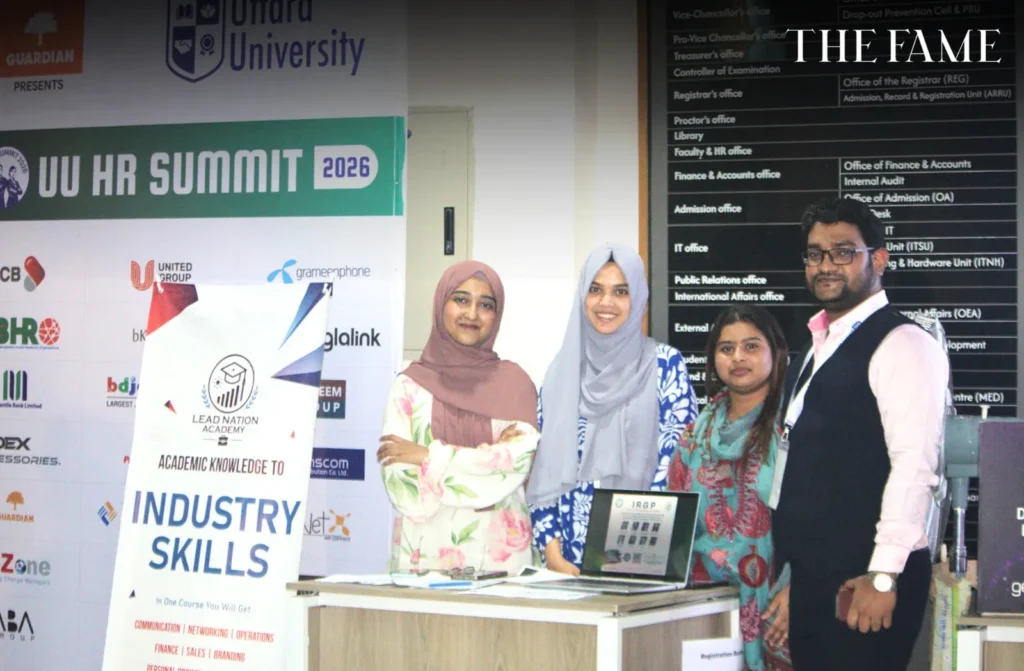
This vision has shaped the Academy’s flagship initiatives, particularly its Industry Readiness Graduate Program (IRGP), which emphasizes communication, leadership, digital competency, artificial intelligence applications, project management, personal branding, workplace ethics, and career preparedness. More importantly, the program encourages students to learn directly from professionals actively working in banking, technology, entrepreneurship, aviation, media, and corporate leadership.
For Mahmud, this interaction is perhaps the most valuable component of modern education.
He believes students should graduate not only with academic credentials but also with confidence, professional networks, practical understanding, and the ability to solve real-world challenges. In his view, industry leaders should no longer remain distant figures invited occasionally for ceremonial lectures; they should become active participants in the educational process.
This philosophy has gradually become one of LNA’s defining characteristics.
The Academy has consistently sought partnerships with universities, corporations, entrepreneurs, and experienced professionals, creating opportunities for students to engage with practitioners rather than relying exclusively on textbooks. Such collaboration reflects a broader global trend in higher education, where experiential learning increasingly complements traditional academic instruction.
Mahmud’s contribution, however, extends beyond entrepreneurship.

Inside Sonargaon University, colleagues and students describe him as an educator who encourages discussion rather than memorization. His classroom conversations frequently revolve around contemporary business challenges, leadership, communication, startup ecosystems, innovation, and career strategy. Instead of asking students only what they have learned, he challenges them to consider how their knowledge can create value for organizations and society.
That perspective is equally evident in his role as Advisor to the Center for Research, Training & Consultancy (CRTC). There, his focus has been on promoting research-informed training and strengthening connections between academic inquiry, institutional development, and professional practice. He argues that meaningful national development requires universities, research institutions, policymakers, and industry to work collaboratively rather than in isolation.
Such thinking reflects a broader understanding of education—not merely as an academic exercise but as an engine for economic transformation.
Bangladesh has entered a decade defined by digitalization, artificial intelligence, entrepreneurship, and demographic opportunity. The country’s young population presents one of its greatest competitive advantages, yet this advantage can only be realized if graduates possess the skills demanded by an increasingly competitive global economy.
Mahmud believes Bangladesh cannot rely solely on curriculum reform to achieve this transformation. It also requires mentorship, professional guidance, industry immersion, entrepreneurial thinking, and lifelong learning. Institutions, in his view, must become platforms where students develop both competence and character.
This belief also explains his growing interest in entrepreneurship development.
Over the past decade, Bangladesh has witnessed remarkable growth in its startup ecosystem. However, many aspiring founders continue to face barriers related to mentorship, investment readiness, strategic planning, networking, and business execution. Mahmud argues that successful entrepreneurship cannot be taught exclusively through business plans or financial models; it requires exposure to experienced founders, continuous mentorship, resilience, communication, and ethical leadership.
Lead Nation Academy increasingly reflects this philosophy by encouraging students not only to pursue employment but also to explore innovation, enterprise creation, and social impact.
His own professional journey reinforces that message.
Rather than limiting himself to one career path, Mahmud has simultaneously contributed to academia, corporate training, entrepreneurship, youth development, public speaking, and institutional partnerships. This multidisciplinary approach mirrors the evolving expectations of modern leadership, where adaptability often matters as much as specialization.
Recognition has naturally followed.
His work has attracted attention within Bangladesh’s entrepreneurship and skills development landscape, while Lead Nation Academy has continued to expand its collaborations with universities, industry experts, and professionals committed to strengthening graduate employability. Yet those familiar with Mahmud suggest that recognition has never been his primary objective. Instead, his emphasis remains firmly on institution building.
That distinction is significant.
Many initiatives are built around personalities; far fewer are designed to outlast them. Mahmud frequently speaks about creating systems rather than events, ecosystems rather than isolated programs, and sustainable partnerships rather than temporary projects. The long-term aspiration for Lead Nation Academy is to become a comprehensive platform connecting students, educators, researchers, mentors, investors, corporations, and entrepreneurs within a single collaborative ecosystem.
If realized, such a model could contribute meaningfully to Bangladesh’s ambitions of becoming a knowledge-driven economy.
The future of higher education is unlikely to be defined solely by lecture halls or examination results. It will increasingly depend on how effectively institutions prepare graduates to navigate uncertainty, embrace technology, lead organizations, and create opportunities for others.
In many respects, Mir Hasib Mahmud represents this emerging generation of educators—individuals who see teaching not as the transfer of information but as the cultivation of potential.
His work suggests that the most valuable qualification a graduate can possess is neither a transcript nor a certificate, but the confidence to apply knowledge in service of society.
As Bangladesh continues its journey toward becoming an upper-middle-income economy, the nation will require more than infrastructure, investment, and technology. It will require leaders capable of connecting education with enterprise, research with innovation, and ambition with execution.
Through his work in academia, research, and Lead Nation Academy, Mir Hasib Mahmud is attempting to contribute to exactly that mission—one student, one partnership, and one opportunity at a time.